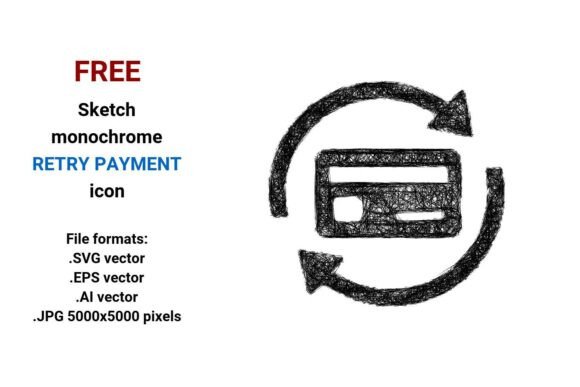
FREE Sketch Retry Payment Icon: A Scalable, Human-Centered Design Asset for Modern Billing Interfaces
When a payment fails—whether due to an expired card, network interruption, or temporary authentication issue—the user’s next interaction is often the most critical moment in the billing flow. That’s where the FREE Sketch Retry Payment Icon steps in: not as mere decoration, but as a functional, empathetic, and technically robust visual cue that guides users toward resolution. Unlike generic “refresh” or “replay” symbols, this icon communicates intent with clarity—retrying a payment, not reloading a page or resubmitting data. Its sketch-style execution adds warmth and approachability, while its vector foundation ensures pixel-perfect fidelity across every screen, device, and context—from embedded dashboards to printed billing reports.
Why Sketch Style Matters in Financial UX
In high-stakes interactions like billing and payments, users subconsciously assess trust through design language. Overly polished, sterile icons can feel impersonal or even intimidating; conversely, rigid, cartoonish visuals may undermine seriousness. The sketch retry payment icon strikes a deliberate balance: it uses hand-drawn line art—slight irregularities, tapered strokes, subtle pressure variation—to evoke human craftsmanship and intentionality. This isn’t “rough” by accident—it’s designed roughness: a signal that the interface acknowledges imperfection (like failed transactions) without sacrificing professionalism.
Consider real-world usage: a SaaS dashboard showing a recurring subscription failure. A flat, geometric “retry” icon might blend into background controls. But a sketched icon, especially one isolated on a neutral background, creates visual hierarchy and emotional resonance. Users report higher confidence clicking a hand drawn retry payment icon because it feels intentional—not automated, not dismissive, but collaboratively corrective.
Vector Precision Meets Practical Flexibility
A vector image is more than just “scalable”—it’s mathematically defined geometry. Every curve, anchor point, and stroke in the FREE sketch black and white retry payment icon is constructed using Bezier equations, meaning it renders crisply at 16 pixels (for a mobile button) or 5000×5000 pixels (for a high-res print invoice header) with zero degradation. This isn’t theoretical advantage—it’s operational necessity.
The package delivers four native formats, each serving distinct production needs:
- .SVG vector: The web standard—lightweight, scriptable, accessible via
tags, and compatible with CSS styling (e.g., dynamic color shifts on hover or error states). - .EPS vector: Industry-standard for print workflows and legacy design tools—ideal for embedding into PDF billing statements or marketing collateral requiring CMYK output.
- .AI vector: Native Adobe Illustrator format—enables direct editing of layers, stroke weights, and typography alignment without rasterization loss.
- .JPG 5000×5000 pixels: High-resolution raster fallback—useful for CMS platforms that don’t support SVG upload, email templates, or documentation screenshots where vector embedding isn’t feasible.
This multi-format availability eliminates workflow friction. A product designer can tweak the retry payment button layout in Illustrator (.AI), hand off the final asset to engineering as an optimized inline SVG, and simultaneously provide marketing with the EPS for a client-facing billing guide—all from the same source logic.
Real-World Applications Across User Journeys
The retry payment icon isn’t confined to error modals. Its versatility emerges across layered contexts:
Billing Dashboards & Subscription Management
In a B2B finance dashboard, failed invoices appear with status badges. Placing the sketch style icon beside a “Retry Payment” action button—rather than generic text—reduces cognitive load. Users instantly recognize intent without reading labels, especially valuable in multilingual interfaces where translation lag or truncation affects clarity.
Mobile Checkout Flows
On small screens, space is scarce—but clarity is non-negotiable. A line art retry payment icon scales cleanly to 24×24px while retaining legibility. Its sketch aesthetic also softens the perceived severity of failure: instead of triggering anxiety (“my card was declined”), it suggests a simple, recoverable step (“let’s try again”).
Educational & Internal Tools
Finance educators use these icons in teaching materials to illustrate payment lifecycle stages. Researchers studying UX patterns in fintech cite scribble icon variants as effective visual anchors in eye-tracking studies—users consistently fixate on them before reading supporting text. Even internal developer documentation benefits: embedding the freehand retry payment icon in API reference pages clarifies endpoint purpose faster than verbose descriptions.
Design Integrity Without Compromise
“Sketch style” doesn’t mean “unpolished execution.” Each FREE Sketch Retry Payment Icon undergoes rigorous design validation:
- Isolation-tested: Renders cleanly against light, dark, and gradient backgrounds—no unintended blending or halo effects.
- Accessibility-optimized: Sufficient stroke contrast (tested against WCAG 2.1 AA standards) ensures visibility for low-vision users, even when scaled down.
- Consistent semantics: The pencil-and-circular-arrow motif universally signals “manual reattempt,” avoiding cultural ambiguity (e.g., no clock or hourglass, which imply delay rather than action).
- Workflow-native: Paths are simplified (not over-compounded), layers are named logically (.AI/.EPS), and SVGs include semantic
aria-labelattributes out-of-the-box.
This attention transforms what could be a decorative element into a scalable UX component—one that supports localization, responsive behavior, and inclusive interaction models without redesign effort.
Integrating the Icon Into Your System
Adoption requires no technical overhaul. Start with low-risk, high-impact placements:
- Replace static “Retry” text buttons in your billing portal’s failed transaction list. Use the SVG inline for full control over hover states and focus outlines.
- Enhance email notifications: Embed the JPG version in “Payment Failed” alerts—its high resolution ensures clarity even when emails render images at reduced DPI.
- Document user flows: Use the .AI file in Figma or Sketch libraries to maintain visual consistency across design system tokens—especially useful for teams managing both web and native app interfaces.
- Extend into physical touchpoints: Print the EPS on welcome kits for enterprise clients, reinforcing brand voice beyond the screen.
Crucially, avoid overloading the icon with competing metaphors. It’s not a “payment confirmation” symbol, nor a “billing cycle” marker. Its strength lies in focused utility: one action, one outcome, zero ambiguity.
Looking Beyond the Pixel: Trends Shaping Payment Icons
The rise of doodle style icon assets reflects broader shifts in digital trust-building. As AI-driven interfaces grow more prevalent, users increasingly value human signatures—even in micro-interactions. A hand drawn icon subtly signals that real designers considered their frustration, their time, and their need for graceful recovery.
Simultaneously, vector-first workflows are becoming baseline expectations—not just for developers, but for compliance officers. Financial institutions now audit UI assets for scalability and accessibility conformance; raster-only icons risk failing automated checks during regulatory reviews. The FREE sketch black and white retry payment icon, with its clean vector lineage and format diversity, aligns with these evolving governance requirements.
Finally, consider sustainability: vector files consume negligible bandwidth versus high-res PNGs or animated alternatives. For global applications serving users on variable networks, that efficiency translates directly to faster task completion—and fewer abandoned retries.
Final Thought: Functionality Woven With Intention
An icon is never just an icon. In billing contexts, it’s a silent negotiator between system reliability and user patience. The FREE Sketch Retry Payment Icon succeeds because it merges three essential qualities: technical rigor (true vector scalability), human resonance (sketched authenticity), and functional precision (unambiguous retry semantics). Whether you’re a solo developer shipping a side project, a fintech UX lead refining a dashboard, or an educator illustrating payment infrastructure, this asset does more than fill space—it builds confidence, reduces friction, and honors the quiet complexity of getting paid.