Peace Bird: Where Calm Meets Creativity
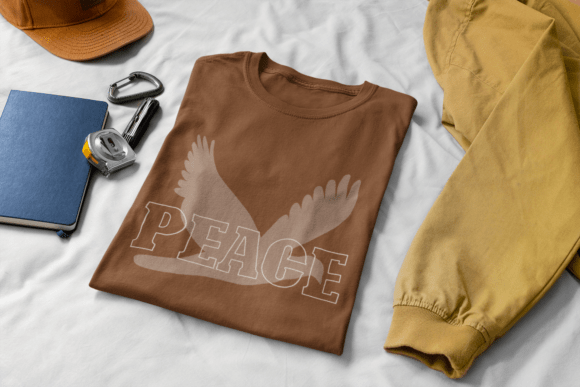
If you’ve ever paused mid-scroll to admire a T-shirt with a soft, hand-drawn bird nestled inside the word “peace,” or noticed how a notebook cover with quiet typography makes your daily planner feel less like a to-do list and more like a gentle invitation—you’ve already felt the quiet power of Peace Bird. It’s not just another clipart-style icon. It’s a thoughtfully crafted visual language: clean typography fused with a delicate, grounded bird motif—no wings flared, no drama—just stillness in motion. That balance is why designers, educators, small business owners, and journaling hobbyists keep returning to it.
More Than a Design—A Quiet Anchor in Busy Days
Think about your morning: coffee mug in hand, laptop open, notifications pinging, a to-do list blinking back. Now imagine that same mug printed with the Peace Typography with Bird design. The subtle curve of the bird’s head aligning with the “e” in “peace,” the even weight of the sans-serif letters—it doesn’t shout. It breathes. That’s the functional magic. This isn’t decoration for decoration’s sake. It’s visual tone-setting. A tactile cue that says, *pause*, *breathe*, *you’re allowed to be here*.
That intention translates across real uses—fast and slow, digital and physical. A freelance writer might print it on a 5×7 sticker and stick it to her laptop lid—not as branding, but as a personal reset button between client calls. A middle school teacher could embed the PNG into a printable mindfulness worksheet, pairing the image with journal prompts like “What feels peaceful to you right now?” A small-batch candle maker uses it on her tote bags—not to sell serenity as a product, but to reflect the calm she hopes her scents evoke.
Where Peace Bird Fits Naturally (and Why It Sticks)
The design’s technical specs—300 dpi, 7777 × 7777 px, transparent background, four high-res PNG files in one zip—aren’t just numbers. They’re what make it *work* without friction:
- T-shirts & apparel: That resolution means crisp detail even on oversized prints—no pixelation when scaled to fit a chest pocket or full-back layout. The transparency lets it sit cleanly over heather grey fabric or textured organic cotton.
- Print-on-demand shops: Upload once, use across mugs, notebooks, phone cases, and wall art. No need to reformat for each product—the size and clarity hold up whether it’s laser-etched onto bamboo or sublimated onto ceramic.
- Digital planning & education: Drop it into Notion templates, Canva lesson slides, or Google Slides for SEL (social-emotional learning) activities. Its balanced proportions scale down to 120 px without losing legibility—perfect for habit trackers or digital sticker packs.
- Junk journals & analog creativity: Print it on vellum, watercolor paper, or kraft cardstock. Cut it out by hand or run it through a cutting machine. The clean lines and intentional negative space mean it layers beautifully with washi tape, pressed flowers, or handwritten notes—never competing, always complementing.
Real People, Real Moments—How It Shows Up
A yoga studio owner added the Peace Bird to her quarterly newsletter header—not as a logo, but as a recurring visual anchor. Subscribers started commenting: *“That little bird makes me slow down before I even read the first sentence.”* She didn’t set out to build brand recognition. She wanted people to feel grounded before clicking “register for class.”
Meanwhile, a homeschool parent used the design in a unit on symbolism. She printed four versions—each file at different sizes—and asked her kids to compare how scaling affected mood: *Does the tiny version feel intimate? Does the large one feel protective? What changes when you crop just the bird—or just the word?* It became a low-pressure gateway into visual literacy.
And for the Etsy seller launching her first line of affirmation stickers? She tested two versions: one with bold, modern fonts, another with Peace Bird. Orders for the latter included notes like *“I put this on my water bottle—I see it every time I take a sip”* and *“My therapist suggested carrying something small that reminds me to pause. This fits.”* That’s not marketing copy. That’s human behavior meeting thoughtful design.
Before You Download—A Few Practical Notes
Because Peace Bird works so well across contexts, it’s easy to assume it’s plug-and-play everywhere. A few quiet considerations help it land right:
- Color matters more than you think. The PNG includes transparency—but if you’re printing on dark fabric or deep-toned paper, test contrast first. A soft charcoal bird on navy works; a light grey on black may disappear. Try inverting the color or adding a subtle drop shadow in your editing tool.
- Scale with purpose. At full size (7777 px), it shines on posters or large-format prints. But for planner stickers or social media banners, scaling down below 1000 px is fine—just avoid stretching it horizontally or vertically. Keep proportions locked.
- Context shapes meaning. Used alone on a minimalist tote bag? It reads as calm intention. Paired with bold slogans (“Breathe Anyway,” “Still Here”) on a protest poster? Its tone shifts subtly toward resilience. Know your audience—and what quiet strength they’re seeking.
- Commercial use is built-in—but check your platform. While the license covers POD, merch, and digital products, some platforms (like certain Cricut design spaces or Redbubble categories) have additional upload rules. Always verify file type and dimensions before publishing.
Not Just for “Peaceful” People—For Anyone Who Chooses Intention
Peace Bird isn’t reserved for meditation apps or wellness influencers. It’s for the graphic designer who needs a calming accent in a busy presentation deck. For the small publisher adding texture to an indie poetry chapbook cover. For the nurse who prints it on laminated cards to leave on hospital nightstands. For the teen building their first bullet journal—not because they’ve “arrived” at peace, but because they’re practicing how to return to it.
Its strength lies in restraint. No gradients. No embellishment. Just a word and a creature, aligned with care. That simplicity is what makes it adaptable—not trendy, not dated, but quietly present. Whether you’re screen-printing fifty mugs for a local café launch, designing a printable self-care kit for your therapy practice, or simply adding one sticker to your laptop as a reminder to exhale—it meets you where you are. And sometimes, that’s exactly what a good design should do.