4th of July Background
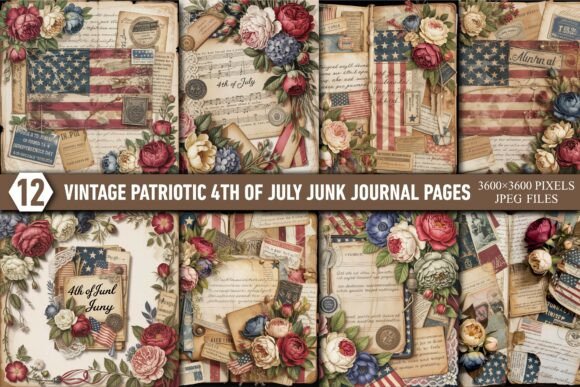
A 4th of July background isn’t just decorative—it’s a functional design asset that anchors creative intention with historical resonance. Whether you’re designing social media posts for a small business, assembling a commemorative scrapbook with family photos, or preparing classroom materials for a civic education unit, the right 4th of July background sets tone, reinforces message clarity, and supports visual consistency across formats. Unlike generic red-white-and-blue patterns, purpose-built backgrounds—like the Vintage Patriotic Junk Journal Pages—embed layered meaning: rustic flags evoke continuity, antique ephemera nods to archival authenticity, lace details add tactile warmth, and floral arrangements soften formality without diluting patriotism. These aren’t afterthoughts. They’re integrated components in a broader creative workflow.
How It Fits Into Real Creative Workflows
Before launching into layout or printing, creators often pause to select foundational assets—fonts, color palettes, templates, and backgrounds. A 4th of July background serves as that first structural decision. For educators building lesson plans, it becomes the base layer for printable handouts or interactive slides. For entrepreneurs running seasonal promotions, it’s the consistent backdrop behind product mockups, email headers, or Instagram story frames. For scrapbookers and journalers, it functions as both canvas and context—supporting handwritten reflections while visually reinforcing the theme of American heritage.
This integration happens early, but its impact extends throughout execution. Because these files are delivered as high-resolution JPGs (3600 × 3600 pixels at 300 DPI), they scale cleanly from digital thumbnails to large-format prints—no reworking needed. That means one selection supports multiple outputs: a single background can appear on a printed poster, a T-shirt design, a Canva social graphic, and a PDF newsletter—all without quality loss or format conversion friction.
Compatibility and Cross-Platform Use
These 12 vintage-inspired pages are built for interoperability. The RGB color mode ensures accurate rendering on screens—critical for digital-first creators using tools like Adobe Express, PicMonkey, or even Google Slides. At the same time, their 300 DPI resolution and 12 × 12 inch dimensions meet print standards for home printers, local print shops, and professional services alike. You don’t need to adjust settings, convert file types, or compromise detail when shifting between platforms.
For designers using Figma or Affinity Designer, the JPGs drop in as locked background layers—ideal for overlaying text, photos, or vector elements. For crafters using Cricut Design Space or Silhouette Studio, they import cleanly as print-and-cut bases or full-sheet backgrounds. Even non-designers benefit: teachers paste them directly into Word or PowerPoint; bloggers embed them in Mailchimp campaigns or WordPress posts via standard image upload.
Practical Implementation Tips
Start with intent. Ask: Is this background supporting reflection (journaling), storytelling (scrapbooking), promotion (marketing), or instruction (education)? That determines how much visual “noise” it should carry. The included junk journal pages strike a balance—floral motifs and lace provide texture without overwhelming, while subtle flag silhouettes and sepia-toned ephemera keep focus on content placed over them.
Organize for reuse. Unzip the folder and rename files descriptively—e.g., “JunkJournal_FlagLace_RedWhite_01.jpg”—before importing into your project library. This saves time during future searches and avoids confusion when managing multiple holiday-themed assets across seasons.
Leverage contrast intentionally. These backgrounds use rich, saturated reds and deep navy blues—not bright primaries. When adding text, choose off-white, cream, or charcoal gray instead of stark white or black for better readability and period-appropriate harmony. Test legibility at actual size before finalizing layouts.
Batch-test across outputs. Print one page at home, preview another in a social post template, and open a third in your journaling app. Note how gradients hold up, whether lace edges remain crisp, and if colors shift between screen and paper. This step catches compatibility issues early—especially important if you plan commercial use (e.g., selling printable kits or themed merchandise).
Integration With Other Resources
A 4th of July background rarely works alone. It pairs with typography choices (serif fonts for vintage gravitas, clean sans-serifs for modern clarity), photo curation (vintage snapshots vs. contemporary family portraits), and physical materials (kraft paper, linen cardstock, or cotton lace trim for hybrid projects). The included antique ephemera—think postage stamps, ledger fragments, or typewritten quotes—can be isolated and reused as standalone embellishments, extending value beyond the background itself.
For educators, pair these pages with primary source documents from the Library of Congress or audio clips of Independence Day speeches. For marketers, layer them under customer testimonials or limited-time offer banners. For hobbyists, combine them with hand-lettered quotes or pressed flower scans to deepen personal resonance.
Quality Control and Long-Term Use
The 300 DPI resolution isn’t just about sharpness—it’s about longevity. As screen densities increase and print expectations rise, low-res assets age poorly. These files maintain fidelity across devices and generations of software updates. Their JPG format avoids proprietary lock-in (unlike PSD or AI files) and loads reliably in virtually every platform, from desktop apps to mobile editors.
Because they’re designed for both personal and commercial use, you can confidently include them in client deliverables, digital product bundles, or small-batch physical goods—no licensing ambiguity. Just verify usage terms apply to your specific context (e.g., resale of printed journals is permitted; embedding in SaaS platforms may require extended licensing).
Workflow Examples Across Roles
- Freelance designer: Use one background as the base for a client’s July newsletter series, then repurpose elements (a corner motif, a flag graphic) as repeating borders across related assets—ensuring brand cohesion without redesigning from scratch.
- Small business owner: Apply a background to a Facebook cover image, then extract its color palette to guide product photography lighting and packaging labels—creating unified seasonal branding in under an hour.
- Classroom teacher: Print four pages at 8.5 × 11 inches for student journaling prompts, then project a full-size version during a discussion on symbolism in American iconography—using the same visual to support both individual reflection and group analysis.
- Hobbyist journaler: Print all 12 pages on matte cardstock, hole-punch and bind into a dedicated Independence Day journal. Add handwritten memories, ticket stubs from parades, or news clippings—letting the background frame lived experience rather than replace it.
Ultimately, a 4th of July background is most effective when treated not as decoration, but as infrastructure—quietly enabling clarity, consistency, and connection. Its value isn’t in standing out, but in holding space: for memory, for meaning, and for the quiet work of honoring heritage through thoughtful creation.